The “6 Degrees of Freedom” in terms of motion is a complex concept, but we see the manifestation of this phenomenon in everyday life almost always! Let me explain by starting with an example.
Just visualize a person holding a coffee cup in mid-air. The 6 degrees of freedom describe every possible way that the cup can move through space.
The Two Types of Movement
[1] Translation (Sliding) – 3 degrees
These are straight-line movements in three directions:
- Left / Right (like sliding the cup across a table)
- Forward / Backward (pushing it away or pulling it toward oneself)
- Up / Down (lifting it or lowering it)
Think of these as moving along the X, Y, and Z axes in Mathematical terms.
[2] Rotation (Turning) – 3 degrees
These are spinning movements around those same three directions:
- Roll – rotating around the forward / backward axis (like tipping a cup to pour)
- Pitch – rotating around the left / right axis (like nodding “yes” with the cup)
- Yaw – rotating around the up / down axis (like shaking one’s head “no” with the cup)
Why It Matters
Any object moving freely in 3D space uses these 6 movements—or combinations of them. This concept is crucial for:
- Robotics (programming robot arms)
- Virtual Reality (tracking any person’s head movements)
- Flight (how airplanes and drones move)
- Gaming (applications of Physics)
The Key Insight
All 6 degrees of freedom are required to completely describe where an object is and how it is oriented in space. If even one is missed, there is no way to fully control or track the object!
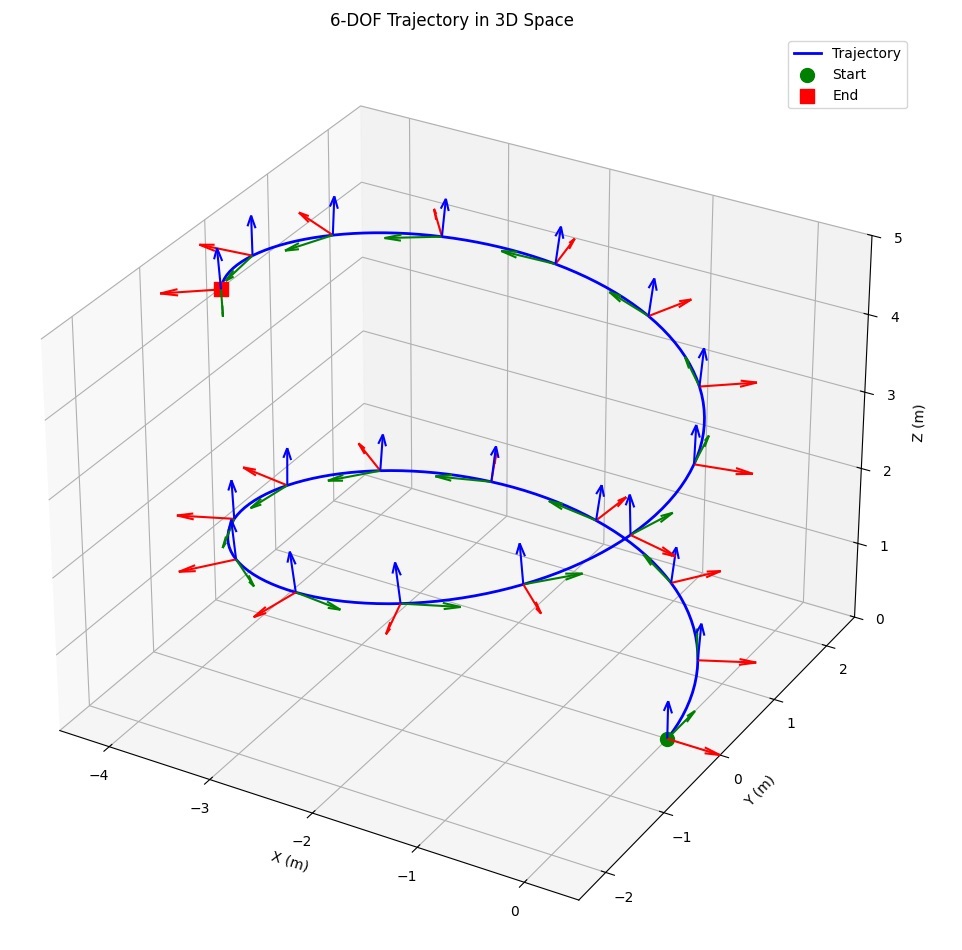
I have written a Python program that, when run, will plot the 3-D space movement of an object. The code is attached as a PDF file, and the plot is given as a graphical image in JPEG / JPG format.